On a group road trip, fuel stops cause more convoy chaos than anything else. On a solo drive, the decision is simple: your gauge drops, you find a station, you stop. On a drive with three or four cars, the same decision involves every driver's gauge, and nobody can see anyone else's.
DriveStream shares each car's tank level and remaining range with the whole convoy, so the group can see the full fuel picture before it turns into a problem by the roadside.
Why fuel stops break convoys
A convoy moves at the pace of its most constrained car. On a fuel stop, that's the car running closest to empty — but nobody knows which car that is unless someone says something. A driver who is nervous about their gauge might stay quiet. The lead car might have had a full tank at the start and isn't thinking about fuel at all.
The standard fix is a group chat. Someone asks how everyone's fuel is doing before a long stretch. Replies come in at different times. Some drivers have already passed the turn-off for the next station. Anyone who misses the message is working from outdated information.
DriveStream removes the question-and-answer loop by making each car's fuel state part of the shared picture every driver already has open.
What each driver tracks
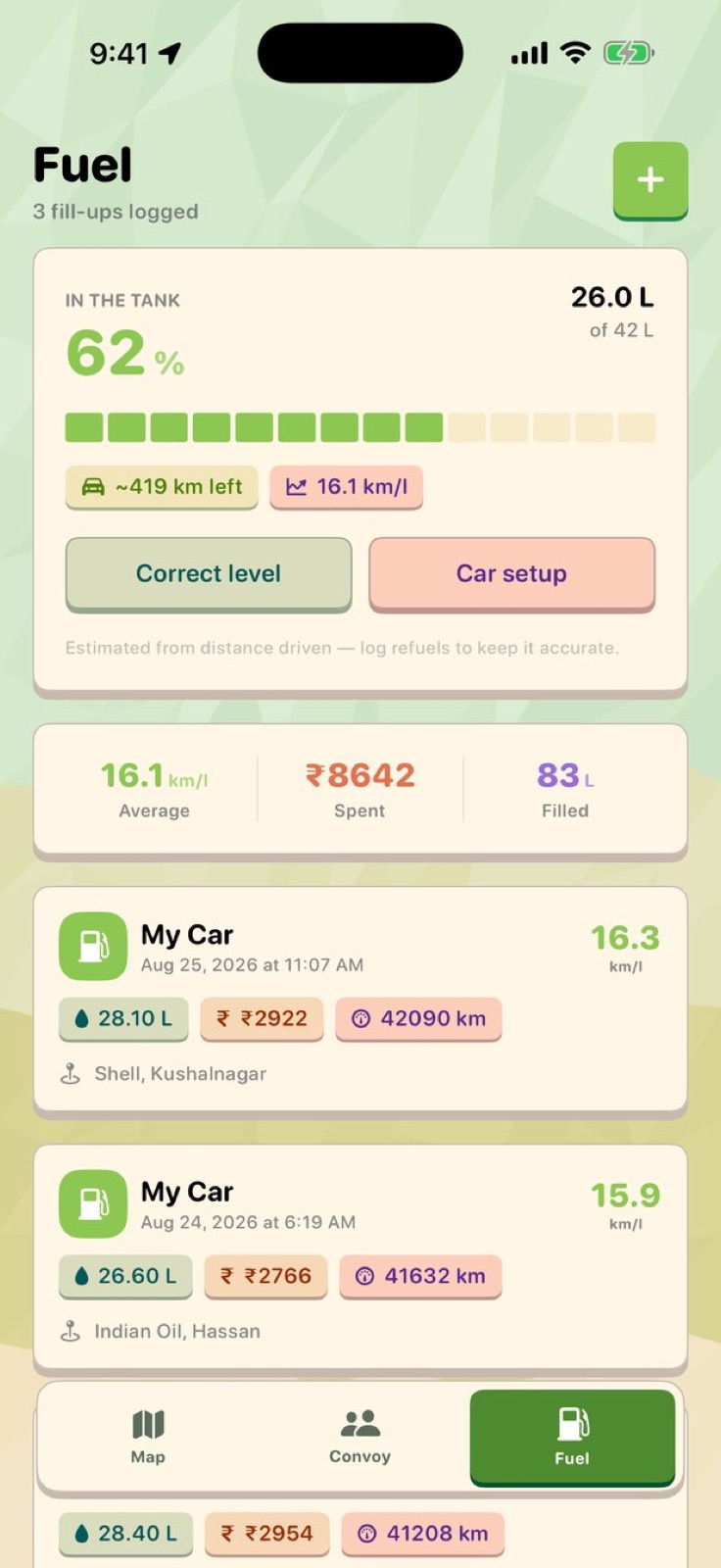
DriveStream includes a fuel tab where each driver logs their fill-ups. When you stop at a petrol station, you record how much fuel you added. The app tracks your fuel level from that log and estimates your remaining range using the economy figure it builds from your history.
You set your starting state when you join a trip. Most car dashboards show a remaining range rather than a volume — DriveStream accepts either, so you can enter what your dashboard shows without converting it.
Over the course of a trip, the range estimate gets more accurate the more fill-ups you log. The fuel tab keeps a running record: how much you added at each stop, and what the economy figure was at that point.
What the convoy sees
The fuel state you track is shared across the convoy. In the convoy list — the tab that shows every car's position and stats — each car displays its fuel level alongside its speed and phone battery. The lead driver can see the rearmost car's range at a glance, without sending a message.
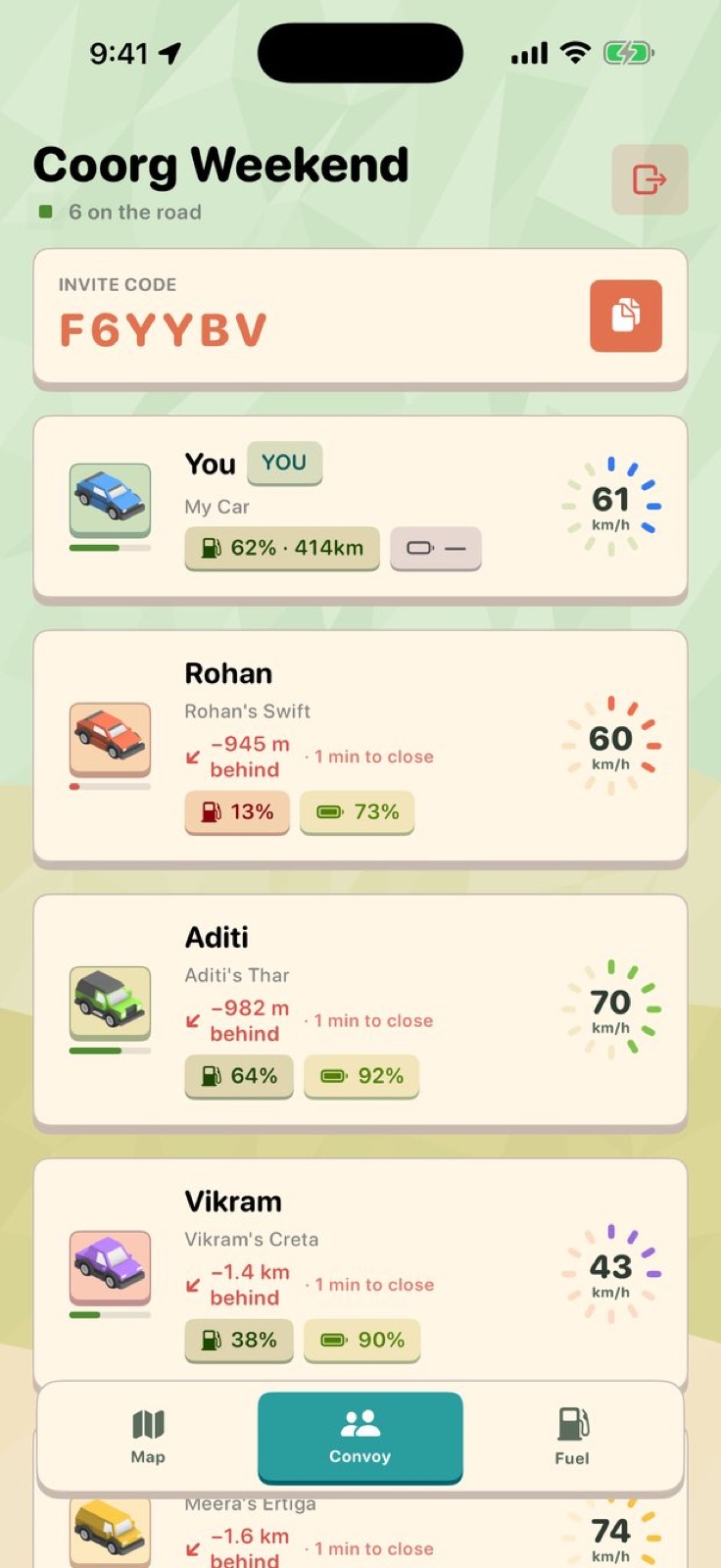 The convoy list: gap to the car ahead, fuel level and battery are visible for every car.
This changes when fuel stop decisions happen. On a route where stations are frequent, the timing of a stop is mostly a comfort call — everyone has enough range to reach the next one whenever it suits them. On a rural road with a long gap before the next station, seeing that one car has much less range than the others is information you want before you pass the last viable turn-off.
Seeing that spread across all cars means the convoy can make the right call for the group, not just for the lead car.
Planning stops before you leave
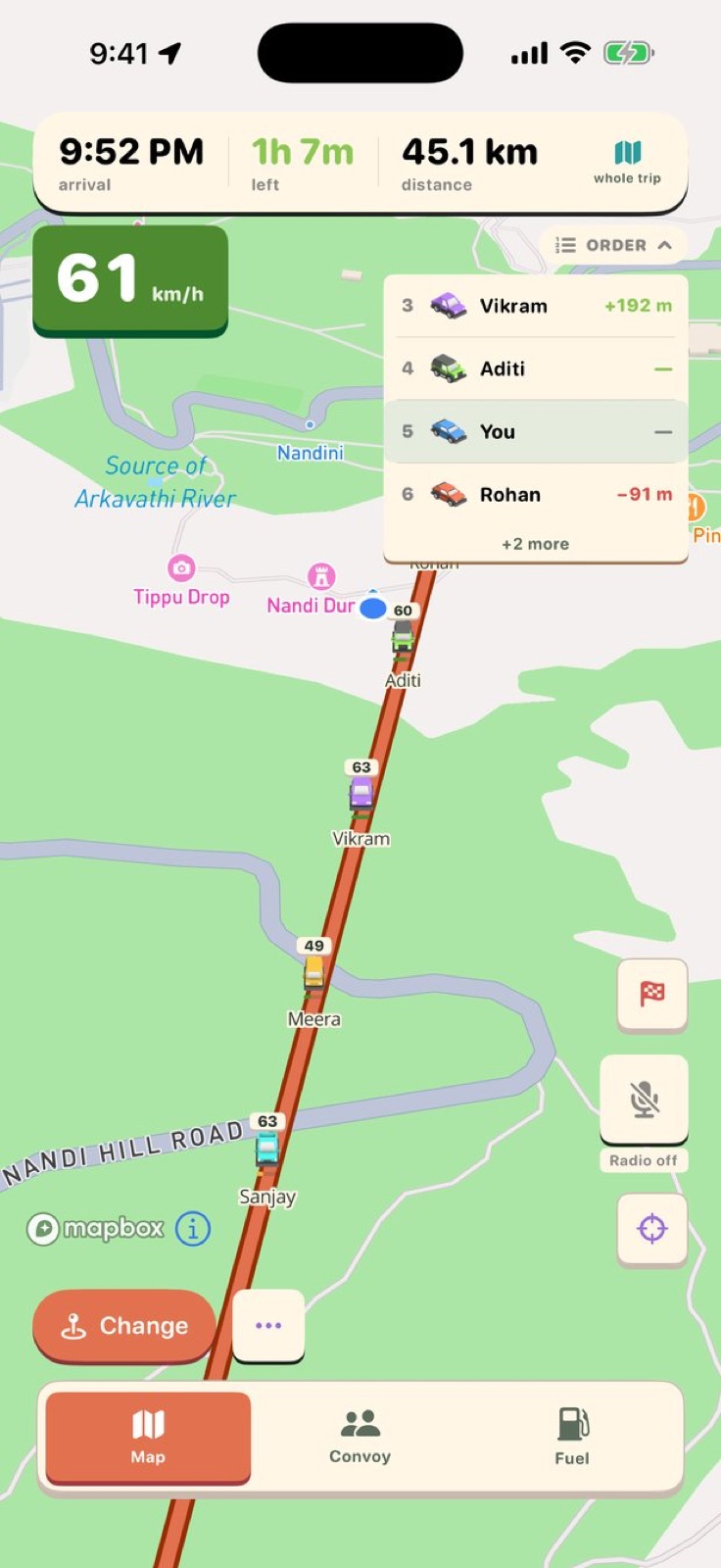 The convoy map: every car's position, speed and ETA update continuously for the whole group.
DriveStream lets you add stops to the shared route before anyone pulls out of the driveway. If you know there's a good petrol station at a sensible point along the way, add it as a stop in the shared itinerary. It appears on every driver's phone immediately, with turn-by-turn guidance directing everyone to the same place.
Setting a shared fuel stop means one less thing that needs a round of messages. The plan is in the app before the trip starts, and every driver's navigation follows it.
If you add a stop mid-drive — because a car's range turned out lower than expected, or because the original stop was bypassed — the change goes to every phone right away. There is no separate update to send; the itinerary on everyone's screen changes when you change it.
Trips support multiple stops, so you can plan the whole route in advance: a fuel station, a rest area, a lunch spot. All of it feeds the same shared navigation for the entire convoy.
The moment the road gets quiet
The practical difference fuel sharing makes shows up at the point where petrol station density drops. Before a motorway, stations are close enough that no car is likely to run into trouble. Once the convoy leaves the motorway and heads into open country, the picture changes.
DriveStream's convoy list gives every driver the same answer at that moment: here is what each car has left. The convoy can decide whether to stop at the next available station or keep moving based on the actual fuel state of every car, not just the lead driver's gauge and an assumption that everyone else is fine.
That used to mean a question in the group chat, a round of replies, and someone doing mental arithmetic while keeping their eyes on the road. DriveStream puts the answer in the list that every driver already has open.
Location stays in the convoy
One thing worth noting for group trips: DriveStream has no ads, no analytics SDKs and no trackers, and your position is shared only with the drivers in your convoy. When you leave a trip, sharing stops. The app's privacy page covers the details.
Fuel data follows the same rule. The tank level and range the app calculates are shared with your convoy and no one else.