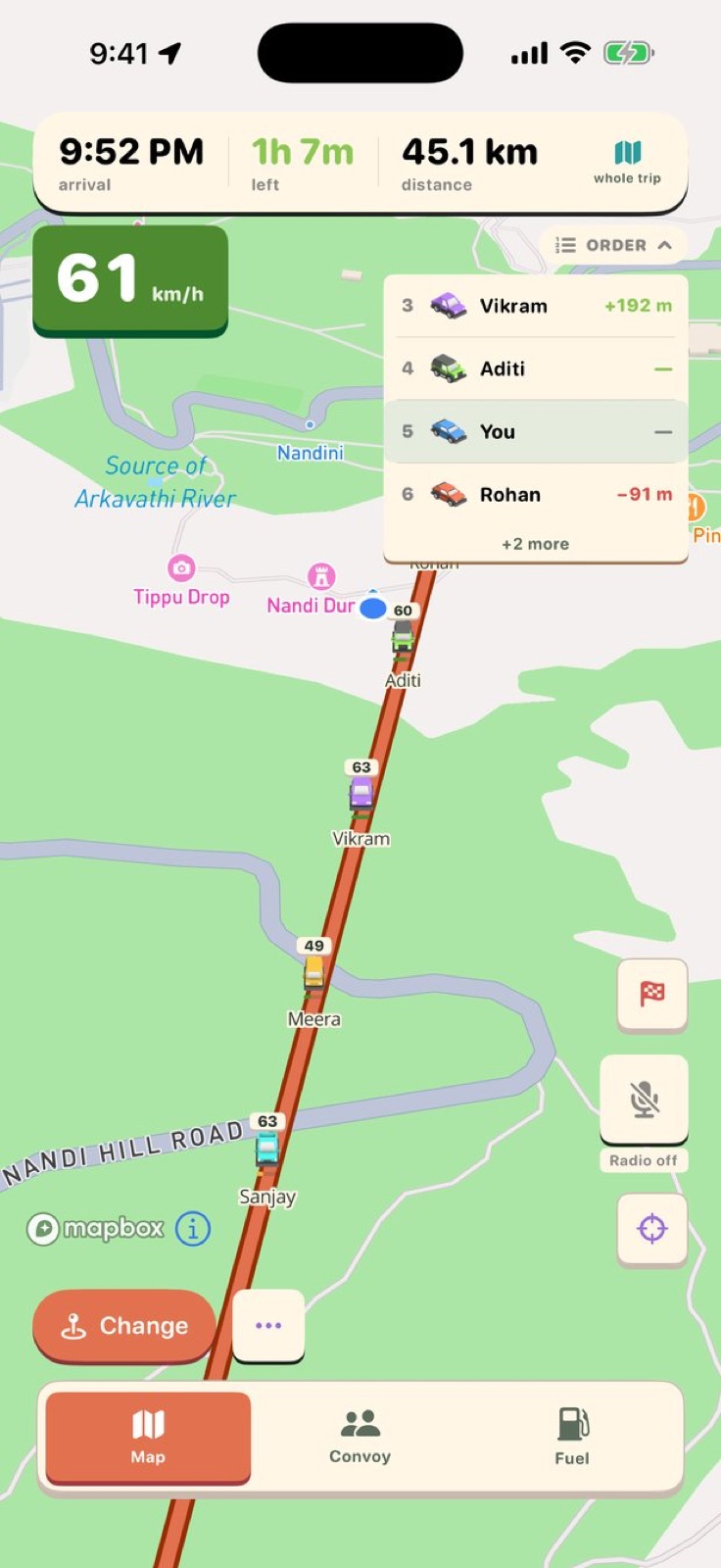
The app was draining the battery even when nobody was driving. Three short prompts fixed that, then closed a gap in group rides, then taught the app how to pause cleanly while you eat.
DriveStream launched on 7 October 2026 after a build that moved fast: a live convoy map, turn-by-turn directions shared to every phone, CarPlay support, animated drive replay, and a press-to-talk radio. What it was missing was anything like careful handling of the gaps between the driving itself — what happens when you park overnight, stop for lunch, or need one person to control when a convoy starts and ends.
These aren't edge cases. They're what every real road trip includes.
Location when you're not moving
The first sign something was off came not from a bug report but from a battery bar. The app had been built to use location actively while tracking a trip, which is correct. But it was also holding location access when no trip was running, which is not. No CarPlay connected, no Bluetooth handoff to the car, no trip in progress — and the GPS was still live.
The prompt that fixed it:
when not in carplay/bluetooth connected or trip actually started we don't even need location data etc
That was the whole thing. Not a bug description, not a stack trace — just a sentence about what the app didn't need. Claude Code traced through the location manager's lifecycle, found where it was staying active after a session ended, and added the condition. After the fix, location requests drop the moment CarPlay disconnects and don't come back until a trip starts.
The practical result is that the app can sit on your phone between drives — overnight, through a rest stop, across a whole week — without touching location.
Checking group rides for parity
Solo drives and group convoys were built in parallel, which meant fixes applied to one didn't always land in the other. By the time solo drive recording was solid — background tracking, crash-safe checkpoints, correct route storage — group rides hadn't been tested against those same failure modes.
Before adding anything new, we stopped and asked:
will everything work correctly for group rides also ? anything we need to be aware of ? that we fixed in solo rides that might not be fixed in group rides ?
This prompt didn't produce a feature. It produced an audit. Claude Code went through the solo-drive improvements one by one and checked whether the group-ride path had the same coverage. It found one gap: a background-tracking fix applied to solo sessions hadn't been ported to the convoy path. That got closed.
It's a prompt that only works if you're willing to hold off on new features long enough to check that what you've already built holds up. The convoy map isn't much use if the drive data disappears when the phone locks.
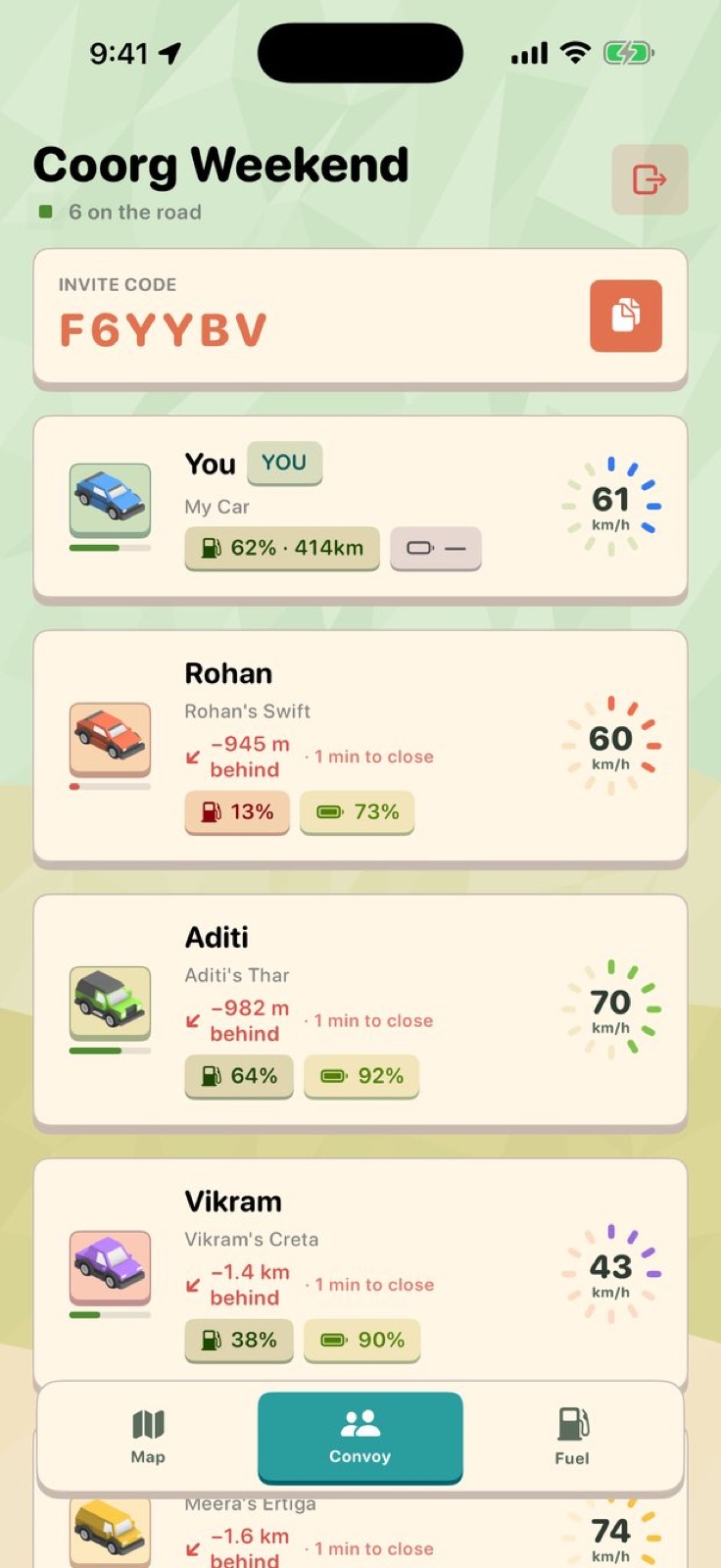
The convoy tab, with each car's gap to the one ahead, speed ring, fuel level and phone battery.
Breaks that don't break the trip
The clearest gap in a long drive is lunch. You pull off the highway at a dhaba or a petrol station, the car goes quiet, everyone gets out for forty minutes — and the app, if you're not careful, files that as the end of the trip and starts a new one when you pull back out.
That's wrong in every way. The stats for the day look wrong. The route looks like two disconnected drives. And in a group trip, if anyone can tap "End trip" while everyone's inside eating, the whole convoy loses its session.
The prompt that covered all of this:
During long rides , we will stop for breaks for breakfast/lunch/ etc it should not get cut off abruptly, group rides can u make it so that only group leader can end the trip manually ? same for start trip also . During breaks maybe you can pause / keep lower battery usage or something .
Three problems in one block. Claude Code handled them in order.
For break detection, it added a pause state the app enters when you stop moving for more than a few minutes: location sampling drops to a lower rate, the Live Activity shows "On break" rather than a speed, and the drive doesn't end. When you start moving again it resumes without any manual step.
For leader control, it added a role check on the end-trip and start-trip actions. Only the person who created the convoy can end or start a shared trip. Everyone else sees the status but not the button. This solved a real coordination problem: in a convoy of several cars, anyone accidentally tapping end would orphan the whole group.
For battery on breaks, the lower-frequency sampling during the pause state means the phone uses less power sitting in a hot car. Location is still live enough to notice when you start moving, but it's not polling at the same rate as an active drive.
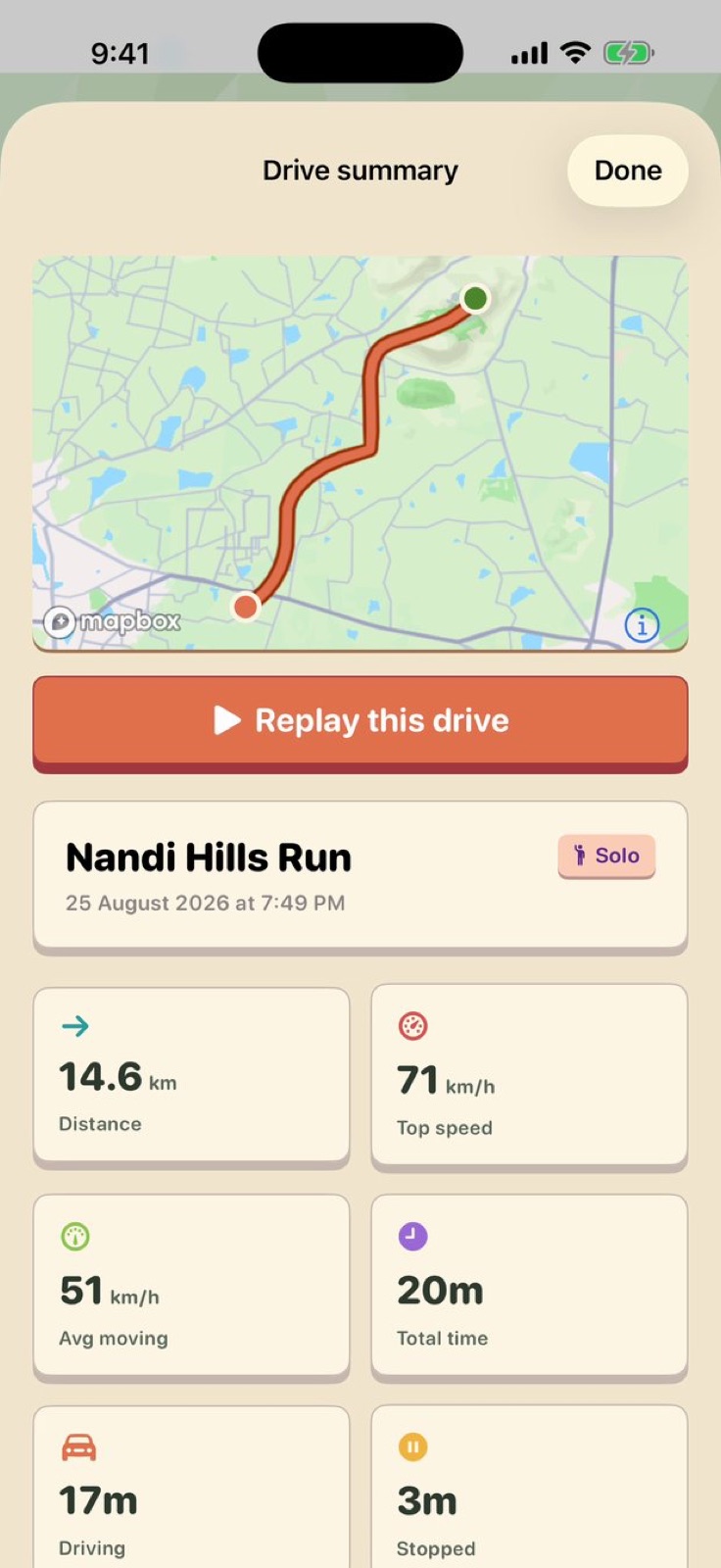
A drive summary after a full day. The route and stats cover the whole day, not just the legs between stops.
What it added up to
None of these three prompts added a tab or a new screen. All three made the app behave correctly in situations that happen on every real drive: parking between uses, stopping for a meal, giving one person authority to manage the convoy. The features that were already there — the live map, the voice radio, the recorded drive — kept working. These prompts just stopped the app from working against you between uses.
DriveStream is on the App Store for iPhone, with CarPlay support, and has no ads. If you're planning a long drive with others, drivestream.app has the details.