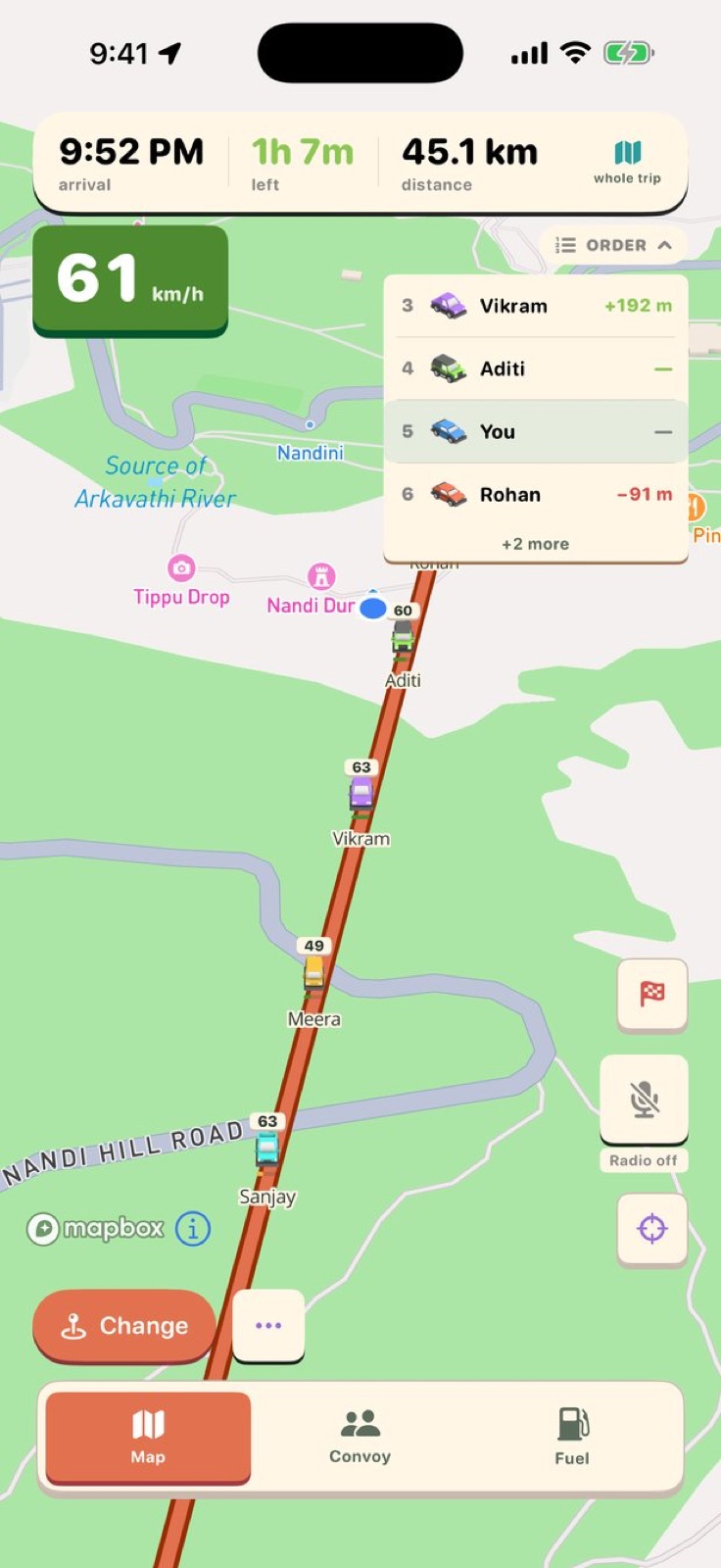
If you're doing a road trip in two or more cars and want everyone to arrive together, DriveStream puts every car on a shared live map — position, speed, heading and fuel level — visible to every driver at once. It runs on iPhone with CarPlay support, and the location is shared only within the convoy you create.
Here is what that looks like across a day on the road.
One map for every car
The first problem with a multi-car road trip is that each driver has their own view. Navigation apps show where you're going; they don't show where the other cars are or whether they're keeping up. You end up coordinating through a group chat, which is exactly the place nobody should be reading while driving.
DriveStream replaces the group chat with a shared convoy map. When a convoy is running, every car appears on the same map with its current speed and heading. A running order shows who is leading and who is behind. The gap between each car and the one ahead is updated continuously so everyone can see at a glance whether the group is tight or stretching out.
The convoy list goes into more detail: each car's exact gap to the one in front, a speed ring, fuel level and phone battery. The front car can see whether the last car is keeping pace or falling back, without anyone having to send a message.
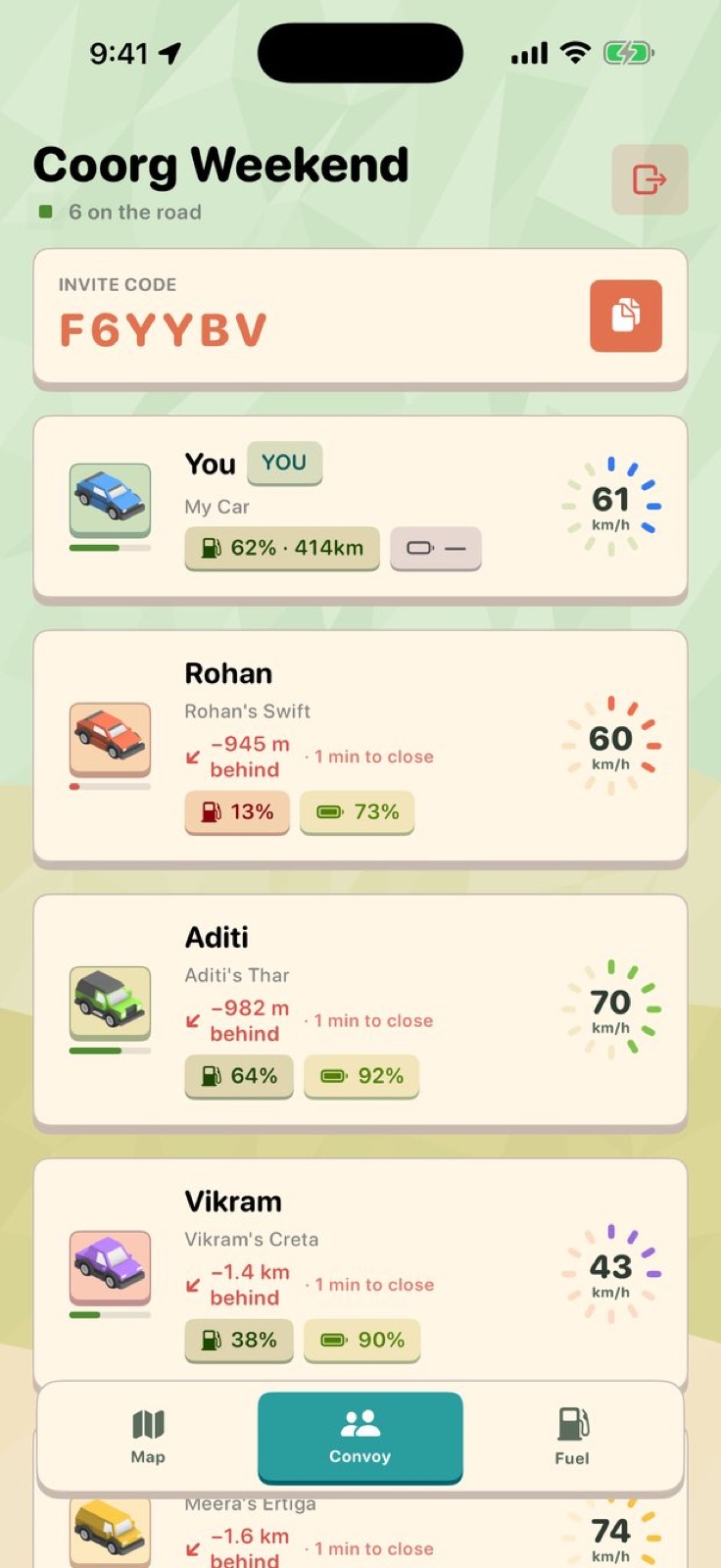 The convoy list: gap to the car ahead, real-time speed, fuel and battery for every car in the group.
A shared destination with stops along the way
Every car in the convoy shares the same destination, with traffic-aware ETAs to each phone and turn-by-turn guidance for every driver. Trips can have multiple stops — a breakfast place on the way out, a viewpoint halfway through, a fuel station, a hotel at the end — and the shared route covers all of them. When the first cars arrive at a stop, the map shows who is still driving and when they will arrive.
This matters most when the convoy has spread out over a long motorway stretch. One car might have checked in and found a table. Two more are five minutes out. The last car is twenty minutes behind because it stopped for a bathroom break. Everyone can see this in the app without anyone having to coordinate by message.
When conditions change — traffic, road closure, a car that decides to skip a stop — the convoy can update the shared destination and the new ETA reaches every phone immediately.
Fuel stops that work for every car
Different cars have different tanks, different fuel economy and different driving styles. In a convoy, fuel can get awkward: one car's range is running low but the others still have plenty, and no one mentions it until the gauge is almost red.
DriveStream shows each driver's tank level and remaining range to the whole convoy, not just to that driver. When someone is getting low, the whole group can see it and agree on a stop before it becomes a rush. After each fill-up, the fuel log records the economy and remaining range so the picture stays current.
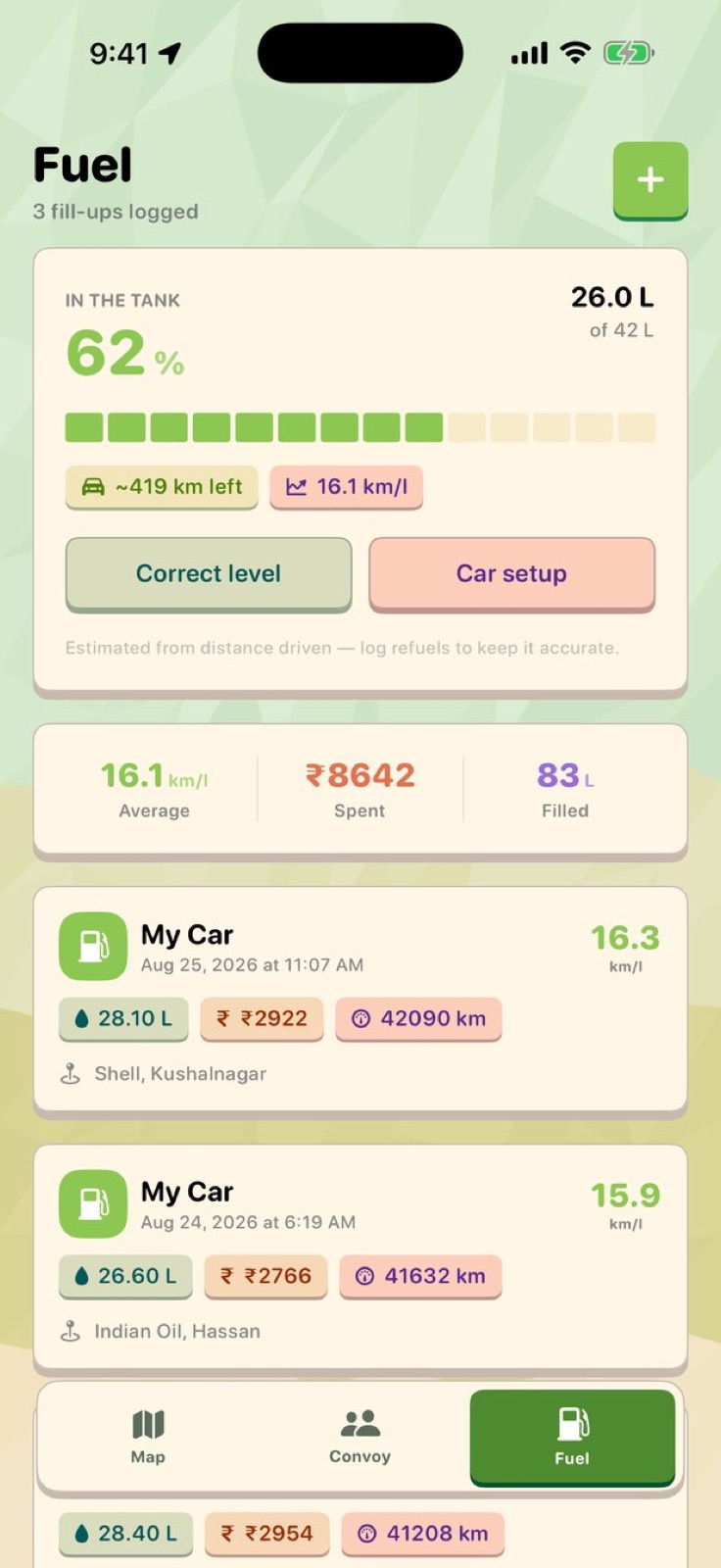 Each car's fuel level and range are visible to the whole convoy, so a stop can be agreed before it's urgent.
Quick voice without stopping to call
Phone calls while driving are a poor tool for convoy coordination: they reach one person, they interrupt navigation, and they force both drivers to manage a conversation while moving. A group chat is worse — nobody should read messages while driving.
DriveStream has a press-to-talk button: hold to speak, release and the voice goes to every phone in the convoy. Live audio only, nothing recorded or stored. It is the right tool for the short messages that actually come up during a drive: "we're pulling off at this junction for fuel", "the GPS says turn right here but the sign says straight on", "is that your car at the front or is there a gap somewhere?"
It doesn't replace a phone call when the convoy stops. It handles the moment-to-moment coordination that phone calls are too disruptive to cover.
Drive recording for every trip
DriveStream records every drive: route at one GPS point per second, total distance, moving time and top speed. Each car has its own log. After the trip, the drive summary shows the exact route with animated replay, available on the phone and in a web companion.
Moving time strips out stationary time — rest stops, fuel fills, the lunch that ran long — and gives the actual driving figure for the day. For a multi-day road trip, the daily summaries build a clear picture of how far you drove each day and when the group was moving versus stopped.
The drives also accumulate toward a rank. Kilometres from every drive carry forward, from Rookie up to Legend, which sits at 40,075 km — the Earth's circumference.
What it needs
DriveStream is on the App Store, free, for iPhone on iOS 26 or later, with CarPlay support. The app has no ads and no analytics library.
A road trip with two or more cars is easier when every driver can see the same map rather than relying on a group chat running in the background. DriveStream gives the whole convoy a shared picture of where everyone is, where they're going and whether anyone's about to need fuel. The app and details are at drivestream.app.